
When Mobile Networks Fail, Could LoRa Keep Emergency Messages Moving?
LoRa Emergency Communication: How No-SIM, Off-Grid Radios Could Help When Networks Fail
By: Javid Amin | October 2026
When mobile towers go down, the ability to communicate can become almost as important as food, water and electricity. A new generation of low-power LoRa devices is offering another option: local, off-grid messaging that can work without a SIM card, cellular subscription or internet connection.
Picture a major earthquake striking a mountain district. Roads are blocked. Electricity is intermittent. Cellular towers are damaged or overloaded. Thousands of people are trying to make calls at the same time.
Then imagine that a small group of rescuers can still exchange short messages, share locations and send emergency updates from one handheld device to another.
That is the promise behind LoRa emergency communication.
LoRa-based systems are not a replacement for mobile networks, satellite phones, professional radio systems or emergency-service communications. They are something different: a low-power radio technology that can be adapted for local communication, sensing and, in some configurations, decentralized mesh messaging.
The distinction matters.
LoRa itself is a radio modulation technology. LoRaWAN is a networking protocol designed primarily for low-power IoT applications. Mesh platforms such as Meshtastic use LoRa radios in a different architecture, allowing participating devices to relay messages between one another.
Understanding that difference is essential before treating LoRa as a disaster-response solution.
But once properly deployed and tested, the technology raises an important question for disaster preparedness:
Can communities build a small communication network that continues working when the conventional network does not?
The answer is potentially yes—but with important conditions.
Why Communication Becomes a Crisis During a Disaster
Disasters do not simply destroy roads, buildings and power lines. They can also disrupt the invisible systems on which modern society depends.
A cellular network requires a complicated chain of infrastructure: towers, backhaul links, power supplies, switching systems, data networks and functioning devices.
A disaster can damage any part of that chain.
Flooding may knock out electrical equipment. An earthquake may damage towers or fibre-optic cables. Landslides can cut roads used by maintenance crews. Cyclones can disrupt power and transmission infrastructure.
Even when the physical network survives, another problem can appear: congestion.
When a disaster occurs, large numbers of people suddenly attempt to call relatives, emergency services or colleagues. Network demand can increase sharply, creating another layer of communication difficulty.
The United Nations Office for Disaster Risk Reduction notes that telecommunications failures can delay emergency response, reduce coordination and interfere with the delivery of warnings and assistance.
This is why disaster preparedness increasingly focuses on communication redundancy.
The idea is simple:
Do not depend on one communication system when the consequences of its failure could be serious.
Mobile networks may be one layer.
Internet connectivity may be another.
Professional radio systems, satellite communications and public-warning systems may provide additional layers.
LoRa can potentially become another small but useful layer for local data communication.
What Exactly Is LoRa?
The word LoRa comes from “Long Range.”
It is a wireless modulation technology based on Chirp Spread Spectrum (CSS). Its major design advantages are long communication range relative to its low power consumption and the ability to transmit small quantities of information efficiently.
LoRa was developed with applications such as low-power sensors and Internet of Things devices in mind.
That means it behaves very differently from Wi-Fi.
Wi-Fi is designed to move relatively large amounts of data over short distances.
LoRa is designed to move relatively small amounts of data over longer distances while consuming very little energy.
This makes it particularly interesting for:
- location information
- short text messages
- sensor readings
- status updates
- alerts
- tracking information
- environmental monitoring
- machine-to-machine communication
It is not designed to stream video or replace a conventional broadband connection.
The simplest way to understand it
Think of three different communication models:
Mobile phone
Phone → cellular tower → operator network → destination
Wi-Fi
Device → Wi-Fi router → local/internet network → destination
Direct LoRa
LoRa device → LoRa radio link → another LoRa device
The last arrangement can work without a cellular tower or internet connection, provided the devices are appropriately configured and within radio range.
That is where the disaster-preparedness potential begins.
LoRa vs LoRaWAN: The Difference Matters
One of the most common misunderstandings surrounding this technology is treating LoRa and LoRaWAN as the same thing.
They are not.
LoRa is the radio technology
LoRa defines the physical radio layer—the method used to transmit information over the air.
LoRaWAN is a network protocol
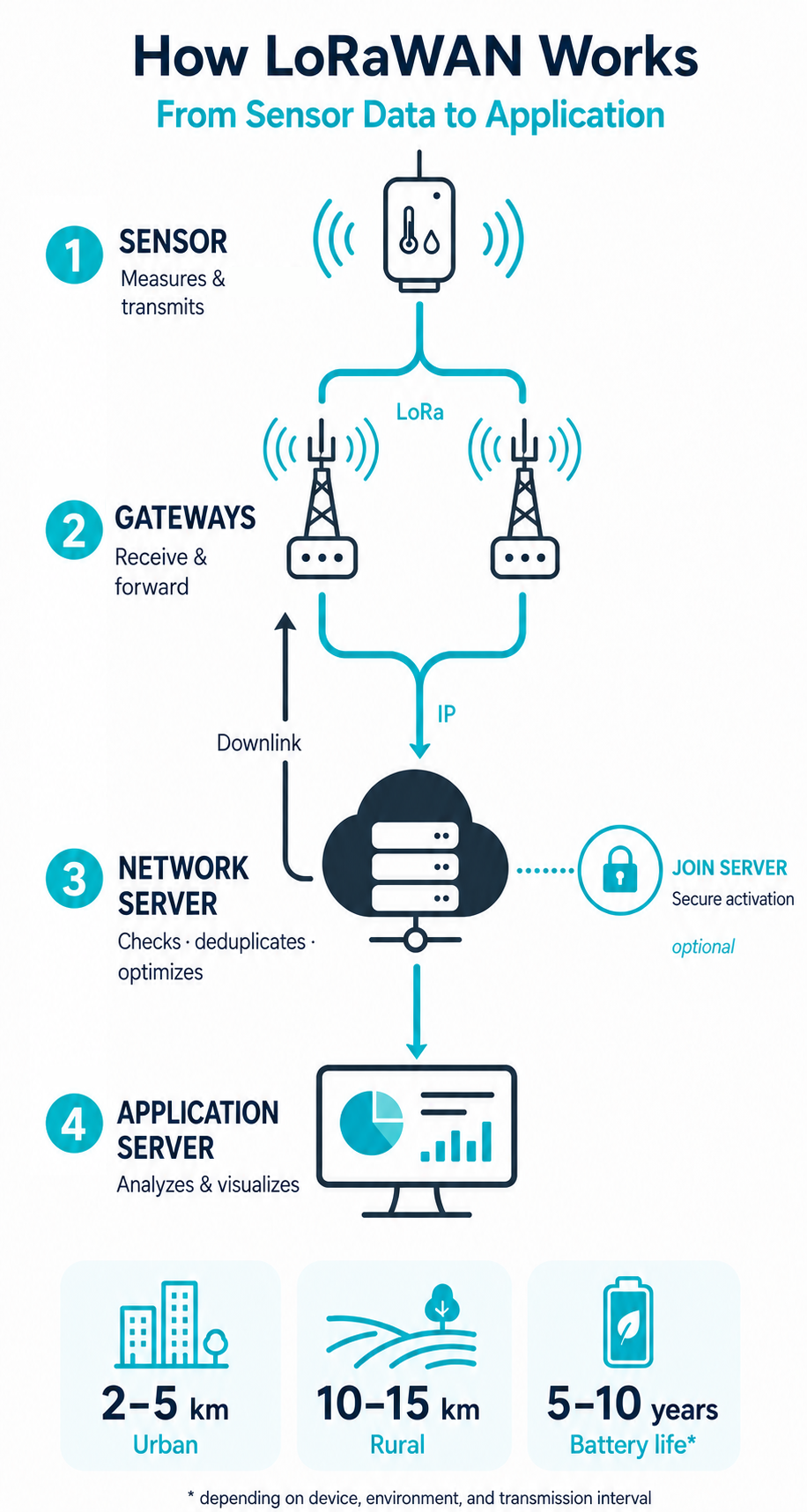
LoRaWAN sits above the LoRa physical layer and is designed primarily for connecting battery-powered devices to wide-area IoT networks.
A conventional LoRaWAN deployment normally uses gateways.
Those gateways receive LoRa transmissions and pass information into a network server, often ultimately connecting the data to internet-based applications.
So while LoRaWAN can provide very long-range connectivity, it should not automatically be described as a completely infrastructure-free emergency messaging system.
Then what is a LoRa mesh?
A LoRa mesh communicator uses participating nodes to relay messages.
For example:
Person A → Node B → Node C → Person D
If A cannot directly reach D, another node may help carry the message.
This is conceptually different from a traditional LoRaWAN star-of-stars architecture.
Open-source projects such as Meshtastic have popularised this kind of off-grid LoRa communication, allowing compatible devices to exchange text and other small data packets without relying on cellular or Wi-Fi infrastructure.
That makes LoRa mesh communication particularly interesting for outdoor groups, preparedness communities and situations where infrastructure has become unreliable.
How LoRa Emergency Communication Works
A basic off-grid LoRa communication system may contain several components.
1. The LoRa Node
This is the small radio device carried by a user.
Depending on the hardware and software, it may include:
- LoRa radio
- microcontroller
- battery
- Bluetooth or USB connection
- small display
- GPS/GNSS receiver
- antenna
Some devices can be connected to a smartphone.
The phone may provide the user interface while the LoRa radio handles the actual long-range communication.
That means the phone does not necessarily need cellular service to exchange messages through the local LoRa network.
2. The Antenna
The antenna is one of the most important components in determining practical communication performance.
A powerful radio with a poor antenna may perform worse than a modest radio with a properly positioned antenna.
Antenna height, orientation, terrain, obstacles and surrounding structures can dramatically affect results.
This is particularly important in mountains.
A device in a valley may have difficulty communicating with another device just a few kilometres away if a ridge blocks the radio path.
Meanwhile, two devices positioned on elevated terrain may communicate across a much greater distance.
3. Intermediate Nodes
In a mesh network, additional devices can act as relay points.
Suppose a rescue team is spread across a valley.
A direct radio connection between the two ends might not be possible.
But if several team members carry compatible nodes, a message can potentially travel through intermediate devices.
This is one reason mesh networks can be attractive in geographically challenging environments.
However, the network becomes dependent on those intermediate nodes being powered, positioned correctly and within radio range.
4. Optional Gateways
Gateways can connect LoRa devices to larger networks.
A gateway may receive radio data and forward it through an internet or other backhaul connection.
That is extremely useful for IoT deployments.
But it also changes the resilience equation.
If the gateway or its backhaul fails, the local LoRaWAN network may no longer provide connectivity to the outside world.
Therefore, a disaster-resilient system should distinguish between:
local off-grid communication
and
communication from the local network to the wider internet.
They are not the same thing.
How Far Can LoRa Really Reach?
This is where online descriptions can become misleading.
You will often see LoRa described as a “10-kilometre” or even “hundreds-of-kilometres” technology.
Neither figure should be treated as a guaranteed operating range.
Radio range depends on:
- frequency
- transmit power
- antenna characteristics
- antenna height
- receiver sensitivity
- spreading factor
- bandwidth
- terrain
- buildings
- vegetation
- interference
- atmospheric conditions
- regulatory limits
- device design
The LoRa Alliance describes typical LoRaWAN deployments as covering several kilometres, while Semtech has published examples of substantially longer links under favourable conditions.
Exceptional experimental distances are not the same as dependable emergency coverage.
For disaster planning, reliability matters more than records
A preparedness team should never say:
“This device can communicate 100 kilometres, so we are covered.”
Instead, it should ask:
“What distance can this particular device reliably cover in our particular terrain, with our antenna and battery configuration?”
That question can only be answered through field testing.
Why LoRa Is Attractive During Disasters
No Cellular SIM Is Needed for Direct LoRa Communication
A direct LoRa radio link does not require a mobile SIM card.
This can be useful when cellular coverage is unavailable.
A smartphone connected to a LoRa node may therefore continue to provide a messaging interface even when the cellular icon shows no service.
But the LoRa devices themselves must be compatible and configured to communicate with each other.
It is not enough for two gadgets to simply contain a “LoRa chip.”
They also need compatible radio settings, software and network configuration.
No Mobile Tower Is Required for a Direct Link
A direct device-to-device LoRa system does not depend on a cellular tower.
That can be valuable when infrastructure has been damaged.
However, this does not mean every LoRa network is tower-free.
A LoRaWAN deployment normally relies on gateways.
The more accurate statement is:
Certain LoRa-based systems can provide local communication without cellular towers, while other LoRa systems depend on gateways and backhaul infrastructure.
That distinction is critical in emergency planning.
LoRa Mesh Communication: The Interesting Part
The most exciting development for disaster preparedness may not be LoRa alone.
It may be the combination of LoRa radios with mesh networking.
A mesh network allows participating nodes to help move messages through the network.
Imagine a trekking group of 15 people.
The first five members are separated from the remaining ten by a ridge.
A direct radio link may be unreliable.
But if several devices occupy useful positions along the route, messages can potentially move through the group.
This creates a decentralized communication system.
There is no single tower that must handle every message.
There is no central mobile operator.
And, in a properly configured off-grid system, internet connectivity is not necessary for local messaging.
Projects such as Meshtastic explicitly promote this model as an off-grid communication platform using inexpensive LoRa hardware.
That makes the technology particularly interesting for:
- trekking groups
- mountaineers
- campers
- disaster-preparedness communities
- rural communities
- overlanding groups
- volunteer organisations
- search-and-rescue exercises
- event organisers operating in remote areas
What Can You Actually Send?
LoRa is not a broadband technology.
Its strength is small, efficient packets of information.
A disaster communication system might be used to send:
Short text
“Team A reached Base Camp.”
Location
“GPS: Team B at Checkpoint 4.”
Status
“Medical kit required.”
Emergency alert
“SOS — injured person.”
Evacuation update
“Route blocked. Use eastern trail.”
Sensor information
“River level rising.”
Weather or environmental information
“Temperature: 4°C.”
These messages can contain valuable operational information without requiring large amounts of bandwidth.
Why LoRa Is Useful for Remote and Mountain Areas
Mountain environments create a particularly difficult communication problem.
A person can be physically close to another person while being separated by:
- ridges
- cliffs
- deep valleys
- forests
- rock formations
- buildings
- bad weather
Cellular coverage may be patchy or completely absent.
LoRa’s long-range, low-power characteristics make it worth considering as one layer in a broader communication plan.
For trekking routes, a prepared network might place relay nodes at strategic locations.
For example:
Base Camp → Ridge Relay → Valley Relay → Trekking Team
Such infrastructure would need to be planned and physically tested before an emergency.
The important lesson is that technology does not remove geography.
A LoRa radio cannot magically communicate through every mountain.
Disaster Scenarios Where LoRa Could Help
Earthquakes
Earthquakes can damage towers, electricity supplies, roads and fibre connections.
A locally deployed LoRa mesh could provide a limited communication layer for teams moving through affected areas.
Possible messages include:
- team location
- casualty reports
- supply requests
- route status
- shelter information
- equipment requirements
Floods
Flooding can isolate villages and disrupt conventional infrastructure.
LoRa sensors can also monitor water levels, rainfall and environmental conditions.
A local network could potentially transmit measurements from remote sensors to a nearby monitoring point.
Again, this should be treated as a supporting system—not as a substitute for official flood-warning infrastructure.
Landslides
Landslide-prone mountain areas can experience sudden road closures and communication difficulties.
LoRa sensors can potentially be used to monitor environmental conditions, while portable nodes can support communication between field teams.
Cyclones and Severe Storms
Power failures and network congestion can affect communications during major storms.
Battery-operated, low-power devices may provide an additional local channel for short messages.
Wildfires
Large outdoor areas can create difficult communication conditions.
Portable LoRa nodes could potentially assist with local coordination, particularly where teams have established a network beforehand.
Remote Trekking Emergencies
This may be one of the simplest consumer applications.
A group travelling beyond cellular coverage can carry compatible LoRa devices and establish a small communication network.
If someone becomes separated from the group, they may still be able to send a short message or location update—provided the radio path exists.
LoRa vs Mobile Networks: Which Does What?
| Feature | LoRa / LoRa Mesh | Cellular Network |
|---|---|---|
| SIM card for direct local communication | Not necessarily | Generally required |
| Cellular tower required | No for direct/mesh communication | Yes |
| Internet required | No for local off-grid messaging | Usually for internet services |
| Typical data volume | Very small | Much larger |
| Text messaging | Yes, with suitable system | Yes |
| GPS/location sharing | Possible with suitable hardware | Yes |
| Voice calling | Generally not the intended use | Yes |
| Video | No practical role | Yes |
| Power consumption | Very low | Generally higher |
| Infrastructure | Can be minimal locally | Extensive |
| Mesh networking | Possible with suitable systems | Not the normal user architecture |
| Best suited to | Small data, sensors, local messaging | General communications |
The important point is not that one technology is “better.”
They solve different problems.
What LoRa Cannot Do
The excitement around off-grid communication can sometimes create unrealistic expectations.
LoRa is not a magical emergency network.
It does not automatically provide:
- nationwide coverage
- guaranteed emergency-service access
- voice communication
- internet access
- unlimited range
- high-speed data
- automatic contact with authorities
A person carrying a LoRa device is not automatically connected to police, ambulance services or disaster-management agencies.
That connection would require an appropriate network architecture and operational arrangement.
Battery Life: A Major Advantage
One of LoRa’s strongest characteristics is low power consumption.
This makes it suitable for devices that need to remain operational for long periods.
In an emergency, battery life can become a critical resource.
A smartphone may consume substantial power when searching continuously for a cellular signal.
A purpose-built low-power LoRa node can be designed to perform a much narrower job.
For disaster preparedness, this opens interesting possibilities:
- battery-powered relay stations
- solar-powered fixed nodes
- environmental sensors
- location beacons
- emergency status devices
But battery claims should always be treated carefully.
Actual operating time depends on:
- battery capacity
- transmission frequency
- GPS usage
- display usage
- temperature
- radio settings
- network activity
- device hardware
A manufacturer saying “months of battery life” does not mean the same thing as months of continuous GPS tracking and frequent messaging.
Security: Useful Does Not Mean Automatically Safe
Another area that deserves attention is security.
Some LoRa-based systems can use encryption, and platforms such as Meshtastic support encrypted communication.
But security depends on the implementation.
A disaster network should consider:
- encryption keys
- device authentication
- access control
- key management
- compromised devices
- lost or stolen hardware
- software updates
- sensitive location information
This becomes particularly important when communicating the location of vulnerable people, medical teams or emergency resources.
A communication network can be technically functional and still be poorly secured.
The India Question: Is Every LoRa Device Licence-Free?
This is one area where users should be particularly careful.
India permits certain low-power wireless equipment to operate in specified licence-exempt bands under defined technical conditions.
The Department of Telecommunications’ Wireless Planning & Coordination Wing has rules covering low-power equipment in the 865–868 MHz range for short-range devices, subject to specified conditions.
At the same time, the DoT states that Equipment Type Approval (ETA) applies to applicable wireless equipment operating in licence-exempt bands and involving RF transmission.
That means the phrase “LoRa is licence-free” is too broad.
The legality of a particular device depends on factors including:
- operating frequency
- transmit power
- technical parameters
- equipment approval
- intended use
- antenna configuration
- applicable Indian regulations
Users should therefore verify that hardware is compliant with current Indian WPC/DoT requirements before deploying it.
This is particularly important for imported radio equipment.
A device being legally sold or used in another country does not automatically make it compliant in India.
Building a Disaster-Ready LoRa Communication Plan
Buying a radio is only the first step.
A genuinely useful emergency communication network should be planned before the disaster.
Step 1: Identify the Communication Problem
Ask:
- Who needs to communicate?
- How far apart are they?
- Is the area urban, rural or mountainous?
- What happens if cellular service disappears?
- How long must the backup system operate?
Step 2: Map the Terrain
Identify:
- ridges
- valleys
- buildings
- forests
- bridges
- evacuation routes
- shelters
- hospitals
- command centres
Radio performance should be tested against the actual geography.
Step 3: Choose Compatible Devices
Do not purchase devices solely because their packaging says “LoRa.”
Confirm:
- frequency compatibility
- Indian regulatory compliance
- antenna configuration
- supported software
- mesh compatibility
- GPS capability
- battery capacity
- weather resistance
Step 4: Test Before the Emergency
This is perhaps the most important step.
Conduct real-world tests.
Try:
- open terrain
- dense urban areas
- valleys
- buildings
- forests
- different weather conditions
Record where communication works and where it fails.
A theoretical range figure is less valuable than a tested coverage map.
Step 5: Establish Message Protocols
Emergency communication should be simple.
Instead of writing long messages, teams can establish short formats.
For example:
MED — medical assistance
SOS — immediate emergency
LOC — location
SUP — supplies required
OK — team safe
This reduces confusion and saves transmission capacity.
A Simple Emergency Communication Model
A community could potentially build a layered system like this:
Layer 1 — Primary
Mobile network / internet
↓
Layer 2 — Local Backup
LoRa mesh communication
↓
Layer 3 — Professional Emergency Communication
Approved radio systems / emergency services
↓
Layer 4 — Long-Distance Backup
Satellite communication where available
This is much more resilient than expecting a single technology to work in every circumstance.
LoRa Is Not the Same as a Walkie-Talkie
A traditional walkie-talkie is primarily designed for real-time voice communication.
LoRa systems are generally designed around small data packets.
That difference is fundamental.
A rescue worker who needs immediate voice coordination may be better served by an appropriate professional radio system.
A remote sensor that needs to report “water level rising” every few minutes may be ideally suited to LoRa.
A trekking group wanting short text and GPS messages in an off-grid environment may find a LoRa mesh useful.
The right question is therefore not:
“Is LoRa better than radio?”
It is:
“What communication problem are we trying to solve?”
The Role of LoRa in Smart Disaster Management
The most interesting future applications may involve LoRa not as a replacement for human communication, but as part of a larger sensor network.
Imagine a flood-prone region with low-power sensors measuring:
- rainfall
- river levels
- soil moisture
- temperature
- water pressure
Those sensors could transmit small packets to local gateways or other network infrastructure.
Similarly, a forest-management system could use sensors to monitor environmental changes.
Agricultural systems can use LoRa for irrigation and soil monitoring.
Cities can deploy LoRaWAN networks for infrastructure monitoring.
In this sense, the technology is not simply about sending messages between people.
It can help create an information layer around the physical environment.
Could LoRa Help During a Complete Internet Shutdown?
For a local mesh system, yes—potentially.
But the scope matters.
If two compatible LoRa devices are communicating directly, their local communication does not require the internet.
If a LoRaWAN system needs to send data to a cloud server, however, it needs an appropriate gateway and backhaul connection.
This distinction is easy to overlook.
A network can therefore be:
Internet-independent locally
while still being:
Internet-dependent for outside connectivity.
That is why emergency planners should identify exactly where the network’s dependencies are.
What Happens When the Power Goes Out?
This is another reason low-power communication systems are attractive.
A disaster network can be designed around:
- rechargeable batteries
- power banks
- solar panels
- vehicle charging
- fixed solar relay stations
But resilience must be designed from end to end.
A radio may have a battery while the gateway does not.
A gateway may have battery backup while its internet connection is down.
A relay node may work while its antenna is damaged.
Every dependency creates another possible failure point.
The Biggest Lesson: Redundancy Beats Technology Hype
The real value of LoRa emergency communication is not that it makes conventional networks obsolete.
It is that it can provide another communication pathway.
That matters because disasters rarely respect technology boundaries.
A flood may destroy electricity but leave some towers standing.
An earthquake may damage towers but leave fibre intact.
A cyclone may cause power failures while the cellular network continues operating intermittently.
A landslide may isolate a small community without destroying the wider telecom network.
There is no universal disaster scenario.
Therefore, there should be no universal communication technology.
A Practical Disaster-Preparedness Checklist
Before relying on a LoRa-based communication system, check the following:
Hardware
- Devices are compatible
- Correct regional frequency configuration
- Regulatory compliance verified
- Antennas tested
- Spare batteries available
- Weather protection available
Network
- Direct communication tested
- Mesh routing tested if applicable
- Relay locations identified
- Coverage mapped
- Dead zones documented
People
- Users trained
- Emergency message format agreed
- Device names assigned
- GPS procedures understood
- Backup communication method available
Operations
- Devices charged
- Firmware/software checked
- Encryption configured where appropriate
- Spare equipment available
- Regular drills conducted
Emergency Planning
- Contact hierarchy established
- Evacuation routes mapped
- Local emergency numbers stored
- Official warning channels monitored
- LoRa treated as a backup rather than the only system
The Future of Off-Grid Communication
The idea behind LoRa is surprisingly straightforward.
You do not always need to move a large amount of information.
Sometimes a few bytes are enough.
A location.
A warning.
A status update.
A request for medical help.
A message saying:
“We are safe.”
In a connected world, that may sound insignificant.
During a disaster, it can be invaluable.
LoRa’s combination of low power consumption, long-range radio communication and flexible networking has created opportunities far beyond conventional IoT applications. Open-source mesh projects are now making the technology accessible to hobbyists, trekkers and preparedness communities, while LoRaWAN continues to support large-scale sensor and infrastructure deployments.
But the most responsible way to view the technology is neither as a miracle nor as a replacement for established emergency systems.
It is a resilience tool.
Its greatest strength may be the ability to add another layer to a communication strategy when other layers become unavailable.
LoRa Emergency Communication: What People Should Remember
The phrase “No SIM, no towers” captures part of the appeal, but it leaves out the engineering reality.
A direct LoRa link can operate without cellular infrastructure.
A mesh system can extend local communication through participating nodes.
LoRaWAN can provide long-range, low-power connectivity through gateways.
None of these automatically guarantees communication during a disaster.
Range varies.
Terrain matters.
Batteries fail.
Antennas break.
Nodes can disappear.
Networks can become congested.
Regulations apply.
And emergency services may not be listening to a private LoRa network.
The smartest approach is therefore to build layered communication resilience.
Use cellular networks when they work.
Use internet services when they work.
Maintain professional radio systems where appropriate.
Use satellite communications where required.
And consider LoRa-based local networks as another tool for short, low-bandwidth communication and monitoring.
In disaster preparedness, resilience rarely comes from one spectacular technology.
It comes from having multiple workable options when the first one fails.
And that may be the most important lesson LoRa has to offer.
Frequently Asked Questions About LoRa Emergency Communication
Can LoRa work without a SIM card?
Yes, a direct LoRa or suitable LoRa-mesh communication system can exchange local data without a cellular SIM. The exact capability depends on the hardware and software being used.
Can LoRa work without a mobile tower?
Yes, direct LoRa links and suitable mesh systems can operate without cellular towers. LoRaWAN deployments, however, normally use gateways and may depend on additional network infrastructure.
Can LoRa send WhatsApp messages without internet?
No. A LoRa device cannot magically make WhatsApp work without internet connectivity. A LoRa-based system can provide its own messaging capability, but that is different from connecting to WhatsApp.
Can LoRa send GPS locations?
Yes, if the device or connected system has GPS/GNSS capability and the software supports location sharing.
Can LoRa be used for voice calls?
LoRa is designed primarily for low-data-rate communication. It is not a practical substitute for conventional voice radio or cellular voice services.
Is LoRa completely licence-free in India?
Not as a blanket rule. India has licence-exempt provisions for specified low-power wireless equipment and frequency ranges, subject to technical conditions. Applicable equipment may also require WPC Equipment Type Approval. Users should verify the current regulatory status of the specific hardware and frequency configuration before use.
Is LoRa useful during an earthquake or flood?
It can potentially provide an additional local communication or sensing layer, particularly when appropriately configured and tested beforehand. It should not replace official emergency communication systems.
How far can LoRa communicate?
There is no single guaranteed distance. Several-kilometre links are realistic in many deployments, while much longer links are possible under favourable conditions. Terrain, antenna height, radio settings, interference and regulatory limits all matter.
Is LoRa the same as Meshtastic?
No. LoRa is a radio technology. Meshtastic is an open-source communication platform that uses LoRa radios to create an off-grid mesh communication system.
Should families buy LoRa devices for disaster preparedness?
They can be useful for certain situations, particularly remote travel and local off-grid communication, but they should be considered one component of a broader preparedness plan rather than a universal emergency solution.
Disclaimer
This article is provided for general educational and informational purposes only. It is not a substitute for official emergency guidance, professional disaster-management advice, telecommunications regulations, or instructions issued by government authorities, emergency services, police, defence agencies, rescue organisations, or local administration.
LoRa, LoRaWAN and LoRa-based mesh communication systems can provide useful supplementary communication capabilities in certain situations, but no technology can guarantee communication during an earthquake, flood, landslide, cyclone, wildfire, conflict, network outage or other emergency. Actual performance depends on device specifications, frequency configuration, antenna quality, terrain, elevation, buildings, weather, interference, battery condition, network design and applicable regulations.
Readers should not rely exclusively on LoRa or any other consumer communication device for life-safety or emergency response. Where available, official emergency numbers, public-warning systems, cellular networks, professional radio systems, satellite communication and instructions from authorised emergency agencies should remain part of an appropriate emergency communication plan.
The terms “no SIM,” “no tower,” “off-grid,” and “long range” do not mean unlimited, guaranteed or universally available connectivity. Direct LoRa communication, LoRaWAN networks and LoRa mesh systems operate differently and may have different infrastructure requirements. Claims regarding range, battery life, coverage or reliability should be independently tested under actual operating conditions rather than assumed from manufacturer specifications or demonstrations.
Regulatory requirements also vary by country and can change over time. In India, users should verify the latest requirements of the Department of Telecommunications (DoT), Wireless Planning & Coordination (WPC) Wing and other competent authorities before purchasing, importing, modifying, installing or operating radio equipment. Equipment that is permitted in one country or frequency band may not necessarily be lawful or compliant in another.
Readers should use only legally approved and appropriately configured equipment, follow applicable radio-frequency and spectrum rules, respect privacy and security requirements, and avoid interfering with authorised communications or emergency-service frequencies.
Any examples of disaster scenarios, trekking routes, rescue operations, communication ranges or potential applications in this article are illustrative and should not be interpreted as operational instructions or guarantees of performance.
In an actual emergency, life safety comes first. Follow instructions issued by authorised emergency services and local authorities, evacuate when instructed, and use established emergency communication channels wherever possible.
Technology can provide redundancy. It should never create false confidence.